
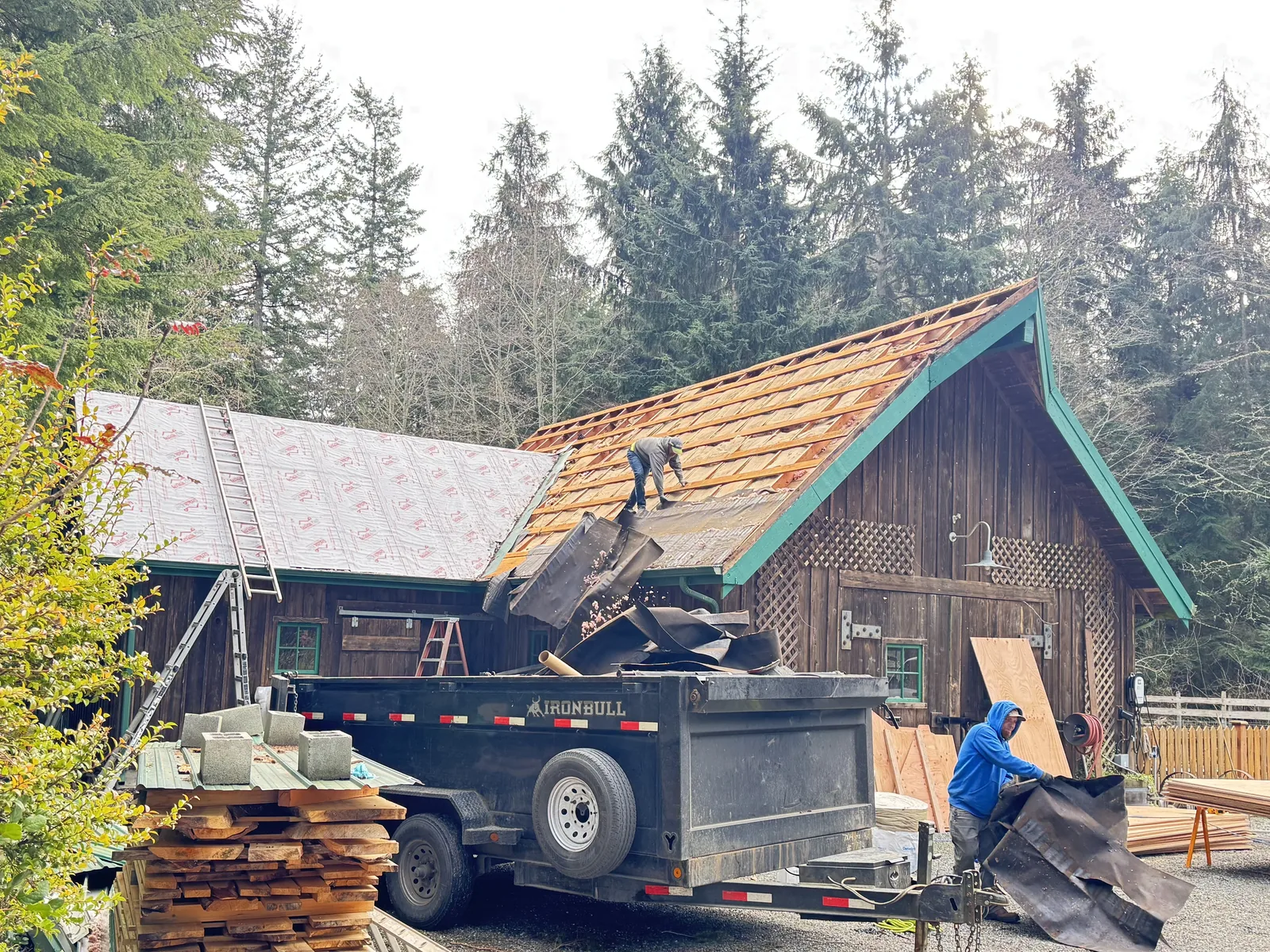
Roof Overlay vs Tear-Off: Which One Does a Washington Roof Need?
Short answer: Washington’s code allows an overlay only in limited cases, and we tear off. An overlay, also called a roof-over or layover, puts new shingles on top of the old ones. The code calls it a recover and allows it over one sound layer. It never allows one over two or more layers, a water-soaked or deteriorated roof, or tile and slate.
An overlay does cost less on day one, because the old roof stays on. One national cost guide puts the saving at about $1 to $2 per square foot. On 2,000 square feet of roof, that is roughly $2,000 to $4,000. These are market numbers, not our price list.
We still tear off, because the decking is where island water damage hides. An overlay leaves that wood covered and adds weight to the frame. New shingles laid over old ones also sit on an uneven surface. Taking the old roof off lets the crew replace bad sheathing and reset the flashing.
Can you put a new roof over the old one in Washington?
Washington’s residential code adopts the 2021 International Residential Code, with state amendments. None of those amendments touch the reroofing section, R908. So the International Residential Code’s reroofing rules apply here as written.
The starting point is a tear-off. The code says a roof replacement removes the old layers down to the roof deck. The one exception is an ice barrier membrane stuck to the deck. It may stay if a new one goes over it.
A recover is allowed when it goes on to the roofing maker’s approved instructions. It is ruled out when the roof already has two or more layers of any roof covering. It is also ruled out over a water-soaked roof, or one too deteriorated to be a sound base. Slate, clay tile, cement tile and asbestos-cement tile cannot be covered either.
Cedar roofs carry one more rule. New roofing over wood shingles or shakes can leave a closed-in pocket that could burn. The code calls that a combustible concealed space. Then the whole old surface gets covered first. The code lists gypsum board, mineral fiber, glass fiber or another approved material.
We take the old roof off. A roof tear-off goes down to bare deck, and to the framing when the framing needs work. If the deck is mostly sound and you want the same kind of roof, the job is a roof replacement.
What does an overlay cost compared with a tear-off?
Roofers price by the square, which is 100 square feet of roof surface. The table below pulls published market ranges from three national cost guides. The guides split the work up in different ways, so the lines do not add up to one total. These are market numbers, not our price list.
| Cost line | Overlay | Tear-off | Source |
|---|---|---|---|
| Tearing off old shingles or metal | Skipped | $1 to $3 per sq ft on average, or $100 to $300 per square | First guide |
| Tear-off, by roof type and number of layers | Skipped | $1 to $5 per sq ft | First guide |
| Tear-off | Skipped | $1.20 to $4 per sq ft | Second guide |
| Disposal of the old roof, 1,800 sq ft example | Skipped | $500 to $1,000 for asphalt, $800 to $1,500 for cedar or tile | Third guide |
| Replacing soft decking | Stays covered | $2 to $5 per sq ft installed | First guide |
| Repairing rotten decking | Stays covered | $3 to $6 per sq ft | Third guide |
| Up-front saving | $1 to $2 per sq ft, or $100 to $200 per square | None | Third guide |
For the whole job, the third guide lists $5 to $7 per square foot for architectural shingles. That price includes tearing off up to two layers. In high-cost cities it runs $6 to $9 per square foot, and Seattle is on that list.
The first guide puts the tradeoff simply. An overlay saves on removal costs, but it shortens the roof’s life. Another national guide puts an overlay’s life at around 16 years. It gives a new shingle roof 20 to 30 years. The overlay also leaves the next roofer two layers to strip, and tear-off prices climb with the number of layers. For whole-roof prices by size and shingle grade, read our roof replacement cost guide.
What does a tear-off find on an island roof?
Whidbey Island roofs see rain nine months of the year. Plenty of them sit in shade under big firs, where moss holds water against the shingles. Water that gets past tired shingles soaks into the decking a little at a time. Soft sheathing and rot only show once the old roof is off.
On an overlay, that wood stays covered under two roofs. On a tear-off, soft decking gets cut out and new sheathing goes in before anything else. Rot in the fascia and trim at the edge gets wood rot repair while the roof is open.
Flashing is the next thing a tear-off fixes. The code says that on any re-roof, old flashings, edgings and vents get replaced where rusted, damaged or deteriorated. Flashings also get rebuilt to the maker’s installation instructions. Salt air and years of wet weather are hard on old metal at walls, chimneys and vents. On a roof with years left, one leak at a chimney or wall may only need roof flashing repair.
Ice and water barrier is the last piece. On a tear-off, we lay it on bare deck at the eaves and in the valleys. On an overlay, the old shingles sit between it and the wood.
Can a metal roof go over shingles?
Sometimes, because metal is light. The code lets a complete standing-seam metal system go over the old roof. The system has to be separate and carry its loads to the building’s structure.
Going over still has costs you cannot see. The decking stays hidden under both roofs. The panels also need a layer between them and the old shingles. Some systems use underlayment laid over the shingles, and some run on wood strips called battens or purlins. The panel maker’s instructions set that, and the flashing still gets rebuilt to them.
Our metal roofing jobs start with a tear-off anyway. Taking the old roofing off is the only way to see the shape of the decking. Where metal itself falls short is covered in our metal roof vs shingles post.
Does a re-roof need a permit on Whidbey Island?
Island County says new and replacement roofing projects require a building permit. Building inspection requests go through the county’s online Public Portal. Plan on a permit for either job, and confirm what yours needs before work starts.
Oak Harbor, Coupeville and Langley run permits inside their own town limits. Mainland towns such as Anacortes and Mount Vernon have their own permit desks. Their rules can differ from the county’s. If you live inside town limits, check with your city’s permit desk. The office that covers your address has the final word.
Which one makes sense for your roof?
An overlay fits a narrow set of roofs. It needs a single layer of shingles that is dry and sound, and a roofing maker whose instructions allow it. It saves money now and leaves two layers for the next roof.
A tear-off costs more on day one. In return, the decking gets checked and fixed before anything covers it again. Our roof replacements start with a tear-off, for shingles and for metal.
If the deck or framing is part of the question, start with tear-off and roof remodel. We come out, look at the roof and give you a free estimate. Call or text (360) 544-9655 and we will get back to you.