
Is Moss on Your Roof Bad? What It Does to Shingles on Whidbey Island
Yes. On an asphalt shingle roof, moss does real damage. The Asphalt Roofing Manufacturers Association says moss can make the leading edges of shingles lift and curl. That is where wind gets under a roof.
Algae is the other growth people see up there. ARMA describes algae as black streaks and discoloration. Moss it treats as a performance problem. If moss has sat on your roof for a few winters, get the shingles looked at first.
We do not sell moss removal, roof cleaning or pressure washing. This guide covers what moss does to shingles here, how it gets treated safely, and what the damage means.
What does moss actually do to asphalt shingles?
Moss is a small plant that takes up water through its leaves. On a roof it settles into the seams between shingle courses. There it holds water against the shingle instead of letting it run off.
ARMA is blunt about where that goes. Moss lifts and curls shingle edges, which raises the chance of blow-off in a wind event. Heavy moss can also move water sideways under the shingles. That ends in a wet roof deck or a leak.
There is a second cost. The granules on a shingle are its sunscreen. CertainTeed says losing granules leaves the roof open to UV and water. Granules come off every time moss is scraped, scrubbed or blasted. That is how a moss problem turns into a roof repair question.
Why does moss grow so well on Whidbey Island roofs?
Moss needs shade and steady damp. Whidbey supplies both. Big Douglas fir and cedar drop needles and cones onto roofs. That debris holds water like a sponge, and a shaded north-facing plane can stay wet for days.
Rain is the other half of it. WSU Extension in Island County reports measurable rain on about 120 days a year here. The Olympic rain shadow then splits the island. WSU puts average yearly rainfall in the 30s of inches on south Whidbey. North of Oak Harbor it runs in the high 20s. The driest pocket sits just north of Coupeville, at roughly 18 to 19 inches.
So a roof in Langley, Clinton or Freeland lives under more moss pressure than a roof in Coupeville. Shade still beats the rain shadow. A shaded north slope in Coupeville or Oak Harbor grows moss just fine.
Timing follows the rain. The University of Washington climate office lists November as the wettest month here. July is the driest.
What is the safe way to treat moss on shingles?
Start with the one rule every manufacturer agrees on. Never pressure wash an asphalt shingle roof. ARMA says a pressure washer causes granule loss and very likely early failure of the roof system. CertainTeed says the same about power washers.
Manufacturer-approved cleaning is chemical, not mechanical. ARMA describes a 50:50 mix of laundry-strength liquid chlorine bleach and water. It goes on with a sprayer and sits for 15 to 20 minutes. Then it gets rinsed off with low-pressure water. Mixing directions vary by shingle brand, so follow the maker of your shingles.
Manufacturers split on brushing. ARMA says not to use a brush or broom, because that friction loosens granules. CertainTeed allows a professional to brush growth away gently with a soft-bristled broom. Read the instructions for your shingles and go with those.
Runoff matters on an island. WSU Extension found zinc, copper and arsenic in most of the roof runoff it sampled around Puget Sound. It notes that very low copper levels can block a coho salmon’s sense of smell. Treat in dry weather, and point downspouts at lawn or a rain garden instead of a hard surface.
Leave a steep, tall or slick roof to a pro. ARMA recommends that only trained professionals clean shingles, because a wet roof is slippery. CertainTeed calls walking a roof dangerous and suggests looking from the ground with binoculars.
Do zinc or copper strips stop roof moss?
They help, with two catches. Zinc and copper wash a trace of metal down the roof with every rain, and moss struggles in it. The strips work on the courses below them, so they go at the ridge and hips.
The first catch is installation. ARMA does not recommend adding strips to a roof that is already down. You either nail through the surface, which can leak later, or break the sealant bond. The clean time to add them is while the roof is going on.
The second catch is the water. Oregon State University Extension does not recommend zinc strips at all. Zinc and copper are toxic to fish and other aquatic life. Weigh that on a waterfront lot at Useless Bay, Saratoga or Penn Cove.
Some shingles carry algae-resistant granules already. CertainTeed’s StreakFighter granules release copper slowly to fight blue-green algae. That is algae, not moss. You still have to keep needles off the roof.
When does moss damage mean a roof repair, and when a replacement?
What decides it is the shingle under the moss.
| What you see | What it usually means | What comes next |
|---|---|---|
| Thin green fuzz in the shingle seams on one shaded slope | Early growth, shingles still flat with their granules | Treat it, clear the debris, watch it |
| Thick clumps on one plane, a few lifted edges, a stain on a ceiling | Water is getting under the shingles or past flashing | A repair: lifted shingles replaced, flashing redone, deck checked |
| Moss across most of the roof, curling edges, bald patches, soft spots | The shingles are near the end and the deck may be wet | A full tear-off and re-roof |
A repair fits when the roof is sound and the trouble sits in one place. That is usually a chimney, a skylight, a valley or a run of lifted shingles. We look at the decking too. A moss-fed leak shows up in the plywood before it shows up on your ceiling.
A roof replacement is the answer when the granules are gone or the edges curl across the whole roof. Same when leaks keep coming back in new spots. Stripping heavy moss off a worn-out roof often finishes it off, so the money goes further on the new roof.
Why does moss slide off a metal roof?
A standing-seam metal panel gives moss almost nothing to grab. The surface is smooth and non-porous. There are no granules or shingle seams to trap needles, so rain runs off fast instead of sitting.
Oregon State University Extension lists metal roofing as one way to keep moss from coming back. Debris still needs clearing, and needles still pile up in valleys.
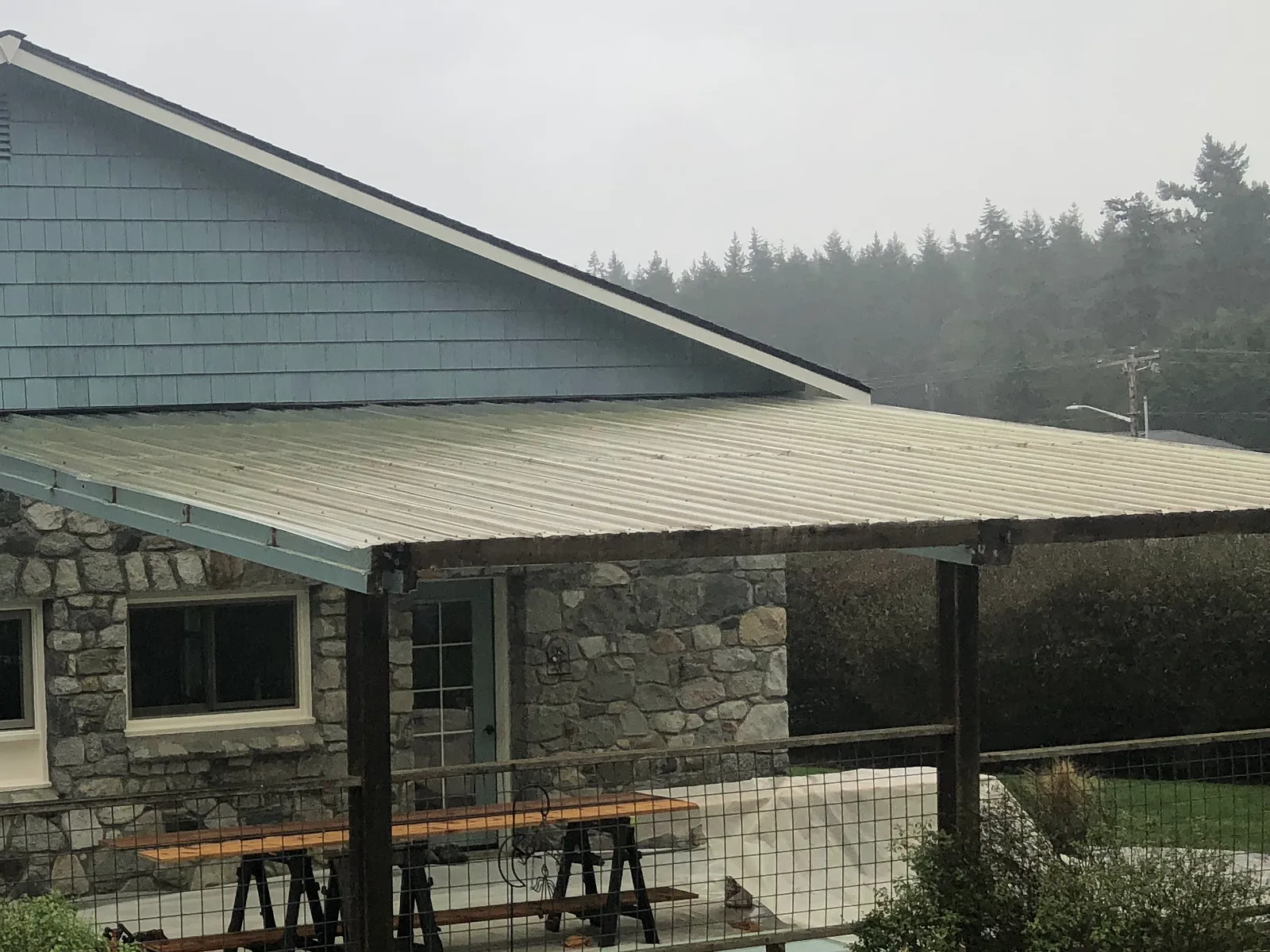
That is a big reason standing-seam metal roofing does well on shaded island lots under firs. We install Nu-Ray Metals panels on houses, shops, barns, carports and patio covers. Weighing panels against shingles? We put metal roofs and shingles side by side in another post.
Getting the roof under the moss looked at
Moss is a symptom. The shingle under it decides your next move.
We are based in Langley, on the south end of Whidbey Island. An island crew comes to you with no ferry wait. Estimates are free. Call or text (360) 544-9655 and we will set up a time to get on the roof.
If the shingles have years left, a repair visit handles the lifted shingles, the flashing and the wet decking. If they do not, we will show you what a re-roof or a metal roof would take.